
Daily Update - June 11th, 2026
Quantum-safe subsea, TSMC CoPos, InP imports from China, Oracle CapEx.

Ever wondered why we need quantum-safe comms already? TSMC packaging gets slick with CoPoS. InP imports under pressure. Oracle CapEx plan makes them slide.
Plus a lot of little tidbits today that are interesting to look into. And a nice graph about the semi market.
It’s time to get into it!
Be sure to check out the Semi Doped podcast on YouTube or your favorite podcast player!
Colt and Ciena complete quantum-safe transatlantic trial
Colt and Ciena completed a quantum-safe optical transmission trial over a transatlantic route between New York and London, which the companies described as the fastest quantum-resistant long-distance data transmission to date.
The trial ran on Colt’s subsea network using Ciena’s WaveLogic 6 Extreme coherent optical technology paired with post-quantum cryptography to protect in-flight data against future quantum-computer attacks.
Colt and Ciena said the test validated the ability to deliver encrypted high-capacity wavelengths across more than 5,500 kilometers of subsea fiber without additional latency, and positions the partners to offer quantum-safe connectivity services to enterprise and carrier customers.
Vik: Why transmit quantum safe bits over subsea? Ok check this out. Turns out several evil folks could intercept encrypted data, store them in someplace safe, and lay in wait for quantum computing to come along. When it does, BAM!, they’ve just unlocked the worlds data and secrets. Better safe than sorry. I love this kind of stuff that’s so weird and far out!
Austin: The pragmatic Midwestern in me initially wants to just roll my eyes and be like “dude, so much marketing hype. feels like a solution that’s looking for a problem….” BUT I can definitely appreciate the severity of not being prepared when quantum computing finally takes off, so I get it. It’s like preppers meets long distance interconnects.
TSMC pulls in CoPoS packaging to 2H 2028
TSMC has moved mass production of its next-generation CoPoS advanced packaging forward from 2029 to the second half of 2028, according to analyst Ming-Chi Kuo. The technology is designed to improve the economics of ultra-large packages above the 9.5x reticle-size class, with Nvidia’s Feynman AI chip cited as a potential first adopter.
Industry checks indicate two glass formats will be used in the process: a 310x310 mm temporary glass carrier and a separate substrate component. The pull-in accompanies broader updates to TSMC’s roadmap covering N2 multi-fab ramp, CoWoS, and SoIC capacity.
(via Ming-Chi Kuo on X)
Vik: CoPoS uses a glass core, but still uses ABF for the routing layer. We will soon be able to package some very large chips. Expected on Feynmann GPUs.
Austin: Yo Vik you should write about CoPos sometime soon.
China stalls InP export approvals despite US pressure
China continues to delay indium phosphide export approvals despite repeated visits by US officials urging Beijing to resolve the bottleneck, according to Reuters. Coherent CEO Jim Anderson raised the issue during a US business delegation trip to China in May, citing constraints on US photonic chip manufacturers that rely on InP for AI data center lasers. AXT and Sumitomo Electric together control 60-70% of global InP substrate supply, materials used in lasers for hyperscaler optical interconnects at Nvidia, Google, Meta, Microsoft, and Amazon. China imposed the export licensing regime earlier this year as part of its broader critical materials controls.
(via Wall St Engine)
Vik: You know, we did an episode long back called Optics Supply Chain: What would you buy? where I explicitly said that I don’t like AXT even if they are like a key supplier because of their Chinese export control exposure. While everybody is fighting over whether CPO is delayed or not, companies are out there trying to make lasers happen. No InP lasers, no optics (pretty much; unless we get relegated to using GaAs VCSELs over MMF. That would suck.)
Oracle Slides On AI CapEx Plans
Oracle shares fell after the company said it plans to raise about $40 billion in debt and equity in fiscal year 2027 to fund its capital investment program, including a previously announced $20 billion at-the-market equity issuance. The financing plan, disclosed alongside quarterly results, overshadowed growth in the company’s AI and cloud business, with investors focused on rising data center costs tied to the buildout. Oracle has been expanding capacity to support cloud infrastructure contracts, including commitments to host AI workloads for OpenAI and other customers.
(via Bloomberg Tech)
Vik: It feels like, with capex, you just can’t win. Spend too much, investors ding you by questioning ROI. Spend too little, investors ding you for being a declining business. Regardless, its an overall positive for the industry when CapEx is still high because companies like Oracle are still spending on AI hardware, which flows downstream everywhere else.
Austin: Oracle is doing interesting things with its infra, I wouldn’t look past that. Hosting it’s software and infra WITHIN competitors clouds! See this. Hosting it’s software and infra within YOUR on-prem cloud, see this. I think they start with customers and work backward and are willing to make interesting trade-offs to win share. It seems obvious — how else can you compete AWS, Azure, Google Cloud — but it takes guts.
Quick Hits
Lumentum CEO teased a new market opportunity (NPO) that he said could be larger than co-packaged optics, framing fresh upside beyond the current LITE story. (TIKR)
Xi’an UniIC, a smaller DRAM rival to CXMT backed by Tsinghua UniGroup, is accelerating a mainland China IPO push amid the memory supercycle. (SCMP)
AI infrastructure demand is squeezing corporate IT budgets and OEM bills of material as advanced memory shortages tighten DRAM pricing and lead times. (EE Times)
Taesung signed an approximately KRW 6 billion contract to supply printed circuit board etching equipment to a customer in China, expanding its substrate equipment footprint. (The Elec)
Nvidia said it has optimized Google DeepMind’s new DiffusionGemma open model for fast local text generation on its GPUs across data center and edge. (Nvidia News)
Infineon will supply 1200V CoolSiC MOSFET power modules to Siemens for next-generation semiconductor circuit breakers, expanding its SiC industrial design wins. (The Elec)
Taiwan data center suppliers report no Nvidia indication of an 800VDC delay, pushing back on rumors that the high-voltage rack standard slips to 2028. (@dnystedt)
Astera Labs told DigiTimes that switch silicon will overtake retimers as its largest revenue driver by end of 2026 as Scorpio ramps with hyperscalers. (digitimes)
Microchip released XpressConnect PCIe 6.0 and CXL 3.1 retimers targeting AI data center architectures and addressing latency at extended bus reach. (EE News Europe)
Taiwan MLCC suppliers face squeezed high-end capacitor supply from AI server and high-voltage demand, pushing some Taiwan firms toward Chinese alternatives. (@jukan05)
Ayar Labs appointed Sejal Patel Daswani as Chief People and Operations Officer to scale the co-packaged optics company globally and build a long-term operating foundation. (Ayar Labs)
Key Data
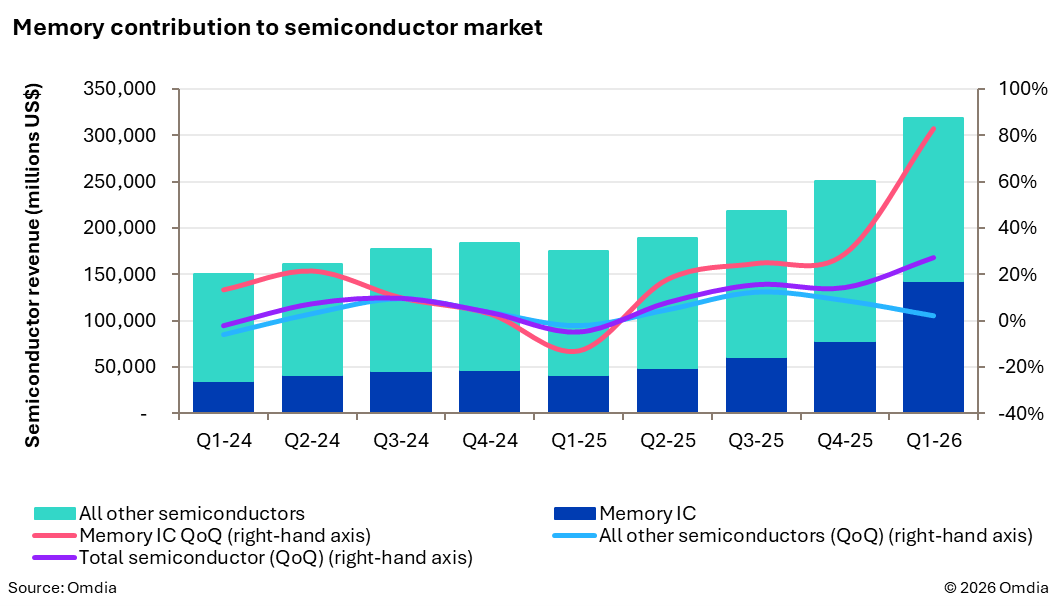
Omdia reported semiconductor industry revenue surpassed $300 billion quarterly for the first time in 1Q26, with memory continuing to drive growth into 2Q.
China isn't planning a D-Day invasion of Taiwan; they’re executing a slow, systematic strangulation. While the U.S. waits for domestic chip fabs to come online in 2030, Beijing is tightening the noose today using the Russian playbook. Here is why a sliver of silicon is the most dangerous geopolitical flashpoint on earth.https://triggledger.substack.com/p/the-silicon-choke-point-why-the-next?utm_source=share&utm_medium=android&r=8gc1qf