Microsoft, Chevron, and Digital Realty ink datacenter deals, ASML faces US accusations over China EUV, Micron and Anthropic sign AI memory pact, Nvidia unveils Vera Rubin and 35 AI supercomputers, Goo
Lots of positive MediaTek news, with 2.4T design wins on TPU v9, Triggerfish, allegedly. Anthropic tapping Micron memory. SK Hynix improves your marriage changes. Qualcomm off buying stuff again apparently.
Shorter edition today since we’re both traveling. Let’s get into it. — Austin & Vik
Quick hits, high signal. Takes from semi industry experts. Sign up for free daily updates!
Be sure to check out the Semi Doped podcast on YouTube or your favorite podcast pl
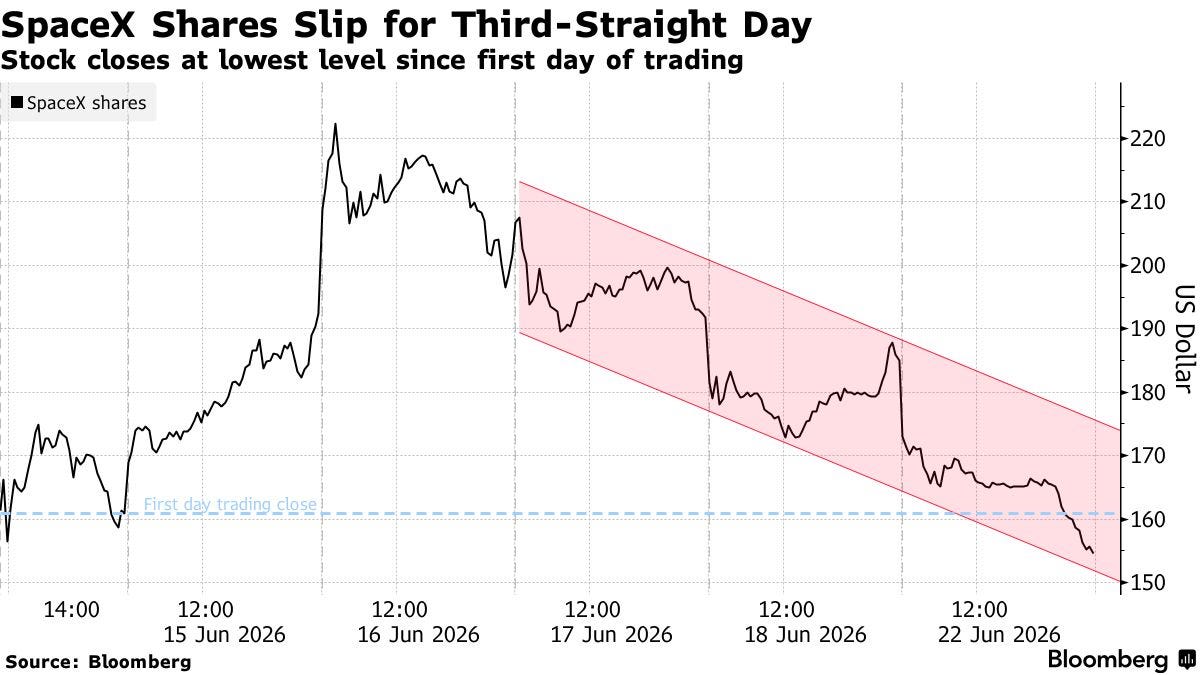
SpaceX Erases $600 Billion in Market Value
SpaceX shares dropped 23% over three days, erasing over $600 billion in market value. The stock now sits at $154.60, though it remains about 15% above its $135 IPO price. The sell-off followed news that SpaceX plans to raise at least $20 billion in bonds to fund AI investments, including a new computing deal with AI startup Reflection AI. Thin trading volume and heavy retail interest amplified the volatility. Investors are also watching SpaceX as a bellwether for the AI race, ahead of expected IPOs from Anthropic and OpenAI, both targeting ~$1 trillion valuations.
MediaTek Secures Google TPU v9 Orders with 336G SerDes Solution
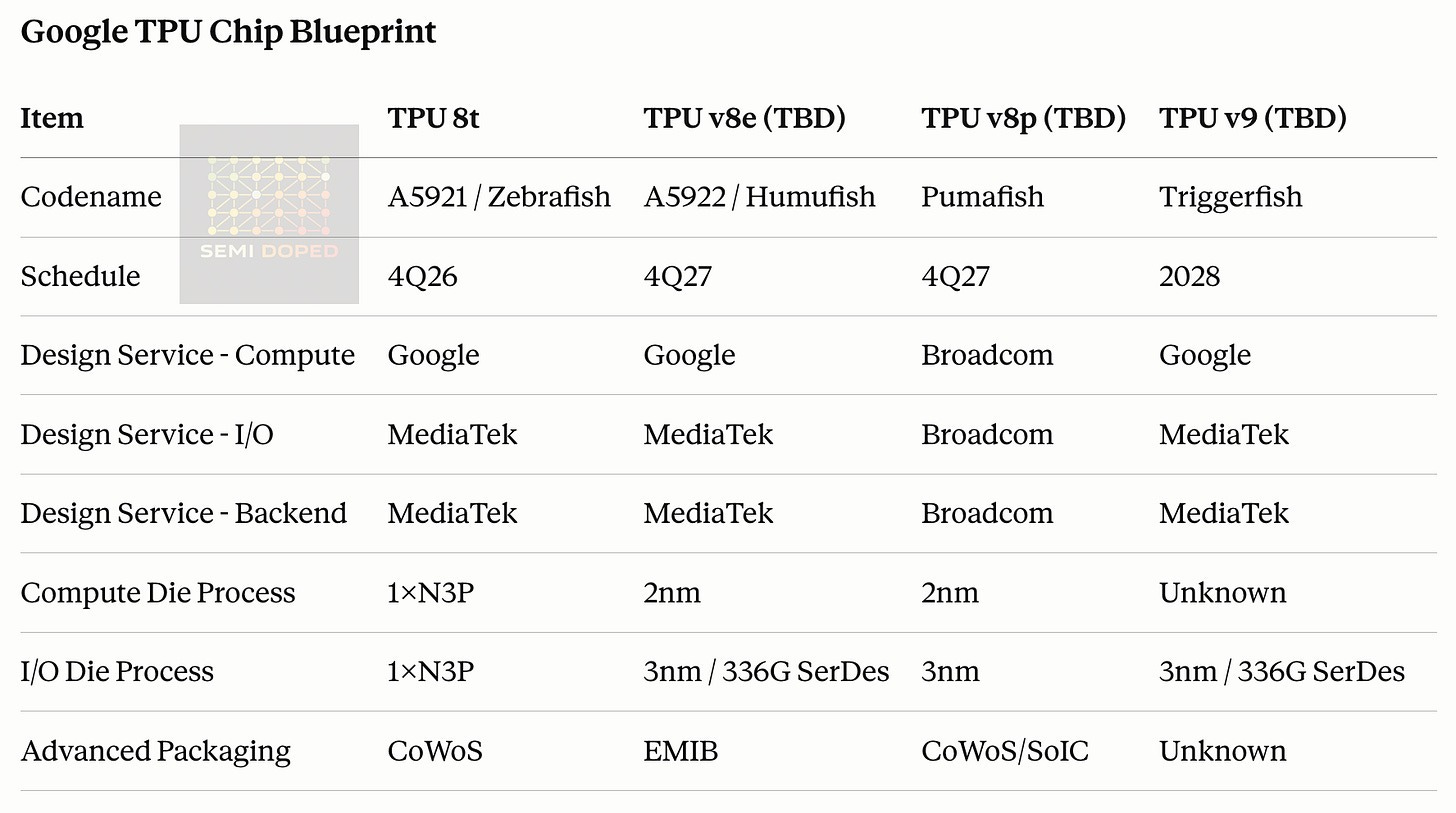
MediaTek has reportedly secured the primary orders for Google’s TPU v9, codenamed Triggerfish, leveraging its 336G SerDes solution.The enhanced design carries roughly three times the memory of the baseline TPU v9 and represents a continuation of Google’s multi-year custom silicon partnership with MediaTek. This win comes as Broadcom, which focused on 448G SerDes, faced delays due to technical maturity and product timeline pressures. Analysts project MediaTek’s AI accelerator ASIC revenue to reach $2 billion in 2026, with further growth anticipated in 2027.(ctee.com.tw)
Vik:There was quite some discussion on X whether MediaTek SerDes was any good due to the choice of their circuit architectures some time back. Even if its not, 300G/lane or 2.4T networking is going to be a reality for Google. If MediaTek now has TPU v9 volume, then that indicates SerDes is just fine.
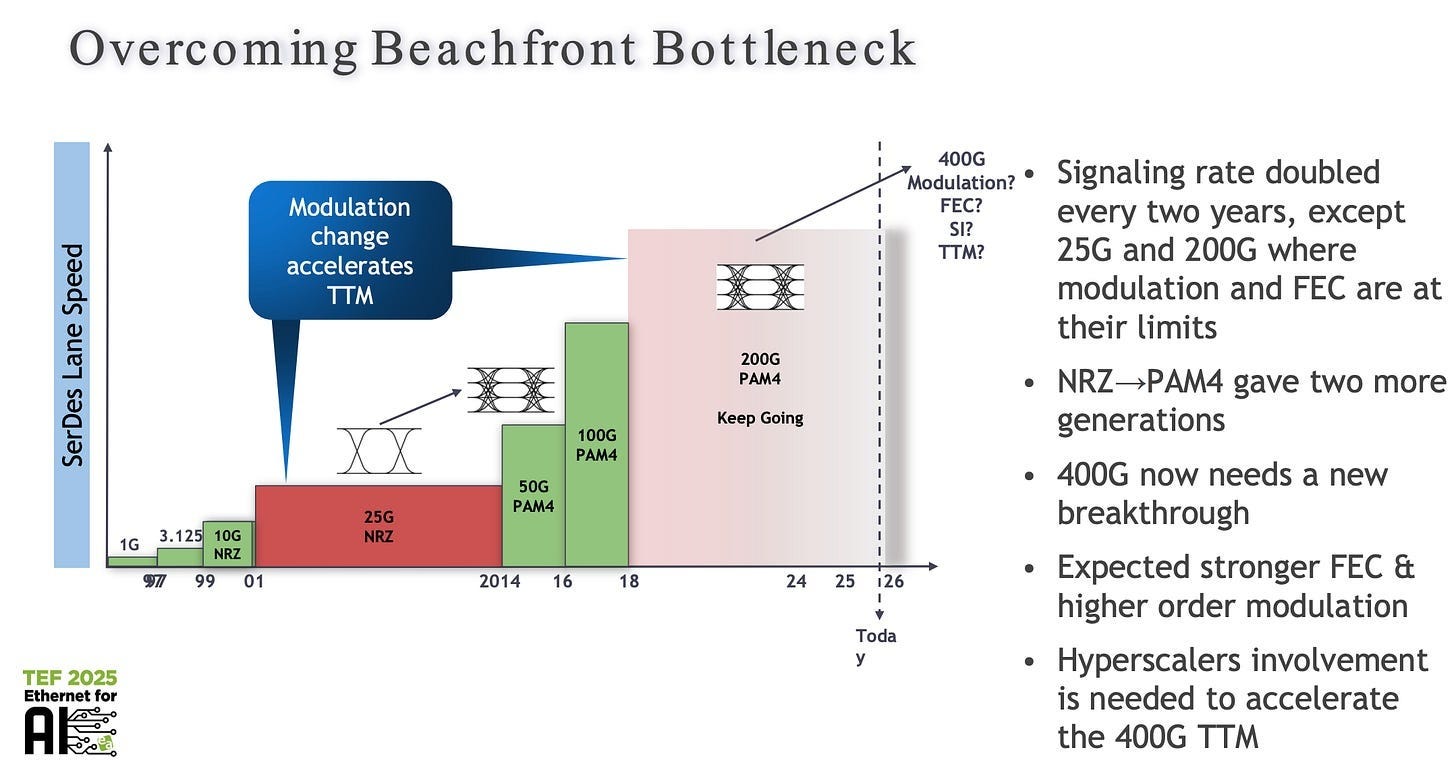
Austin:336G per lane instead of 448G. Interesting. 448G is hard:
Memory Pricing to Surge 40-50% in Q3 2026
Jefferies predicts memory pricing will increase 40-50% quarter-over-quarter in Q3 2026 and another 30-40% in Q4 2026, with continued price hikes into 2027 due to zero wafer capacity growth. Cloud Service Providers are securing 50% of total capacity through two-year long-term agreements requiring 40% prepayment, leaving consumer electronics players facing severe supply pressure. Samsung is expected to gain a competitive edge in HBM4 with its 4nm base die and hybrid bonding transition. (@pequityresearch)
Qualcomm is close to acquiring Modular, an AI chip software startup, according to a Bloomberg News report cited by Reuters. The transaction values the AI chip company at about $4B. Earlier, the Information reported that Qualcomm was in a deal to buy Tenstorrent. (Reuters)
Vik: Why is Qualcomm doing all this M&A stuff? What happened to the inference chip they were building? This week’s investor day will reveal all, we hope.
Austin: We’ll find out tomorrow!
BTW, adding Chris Lattner and Modular would be a slam dunk imo for QCOM.
And previous rumors said Jim Keller’s Tenstorrent is on the table too.
Micron and Anthropic sign AI memory supply pact
Micron and Anthropic announced a strategic agreement on June 22 covering joint design of memory and storage architectures for next-generation AI infrastructure, a long-term supply agreement, and enterprise deployment of Anthropic’s Claude models inside Micron. Micron is also taking part in Anthropic’s latest funding round as a strategic investor. Financial terms and supply volumes were not disclosed. (Micron, EE News Europe, Reuters)
Vik:MU 0.00%↑ hit an all time high for a moment there. If a company with a steeply increasing ARR is going down the supply chain trying to secure memory, what’s next?
Is Anthropic going to acquire InP laser supply too? This is going to happen….
I’ve argued before that there is a pecking order here in the form of a token value chain: supplier → provider → consumer. As computing resource becomes scarce for the provider (Anthropic), they will acquire a larger portion of the supplier universe.
Austin:Memory vendor is a strategic investor in major AI lab. Reminiscent of a time when the news was all about an accelerator vendor strategically investing in major AI lab. Is memory is the belle of the ball right now?
Upscale AI raises $190 million, reaches $500 million total funding
Upscale AI, an AI networking infrastructure company, announced it raised $190 million in Series A-1 financing, bringing its total funding to $500 million and its valuation to $2 billion. Premji Invest led the round, with new investors including Nvidia, Salesforce Ventures, Seligman Ventures, and Temasek. The company is engaged with hyperscalers and neocloud infrastructure providers for customer evaluations and deployments. (businesswire.com)
Austin:Upscale’s SkyHammer switch can support UAL, UEC, and SUE. Which enabled them to give a nice talk back at OCP where they tested and discussed the merits of UAL vs UALoE vs SUE:
Microsoft, Chevron ink Texas AI datacenter power deal
Microsoft and Chevron signed a power supply agreement for a new Microsoft AI datacenter in Pecos, Texas, with Chevron supplying electricity from on-site natural gas turbines under a long-term contract spanning roughly 20 years. The Pecos facility is part of Microsoft’s Azure capacity expansion for AI workloads and is being built with a closed-loop cooling design that Microsoft says uses less water than a fast food restaurant. Reuters reported the arrangement gives Microsoft dedicated, behind-the-meter generation in the Permian Basin, bypassing constrained grid interconnection queues in ERCOT. (The Official Microsoft Blog)
Vik: Seems like the comparison between fast food joints and datacenter water usage as perpetuated by SemiAnalysis is catching on. I suppose everyone can relate to burgers. I’ve argued in the past that the comparison is not as simple as that.
US Accuses ASML of EUV Shipments to China
The US Commerce Department accused ASML of shipping EUV-compatible components to Chinese customers, alleging the transfers may have breached export controls on advanced chipmaking gear. The Bureau of Industry and Security is reviewing the evidence and weighing enforcement action against the Dutch lithography maker, which supplies the only extreme ultraviolet scanners capable of producing leading-edge logic and memory chips. ASML rejected the allegation, saying it complies with applicable Dutch and US restrictions and has not delivered full EUV systems to China. The company has been barred from exporting its most advanced EUV tools to Chinese fabs since 2019, with curbs later extended to some immersion DUV systems. (Tech Times, AI Insider, Electronics Weekly, verdict.co.uk)
Nvidia unveils Vera Rubin platform for science
Nvidia introduced its Vera Rubin accelerated computing platform at ISC High Performance 2026, pairing new Vera CPUs with Rubin GPUs in a rack-scale, liquid-cooled architecture that combines double-precision HPC with large-scale AI workloads. Los Alamos National Laboratory will deploy the platform in three supercomputers — Mission, Vision and Veritas — built with Hewlett Packard Enterprise on the HPE Cray Supercomputing GX5000 architecture. Nvidia is positioning Vera Rubin for scientific research, industrial simulation and agentic AI applications, marking a shift toward unified systems that merge traditional HPC with AI acceleration. (Nvidia News, EE News Europe)
Austin: Hmm. Where does the double-precision (FP64) compute come from in these setups? Rubin can support FP64 no doubt, but has been prioritizing lower precision for AI. Are they running like agentic inference on Vera Rubin and doing all the HPC math on the Vera CPUs? Or using Rubin for the HPC oomph too?
Seems AMD’s MI430X would be a good candidate here too.
Key Data
Translated from Chinese using Claude. Errors are Dario’s fault. From Commercial Times.
Source: Commercial Times
Sector Watch
AI & Compute
SpaceX and Reflection AI sign $150M/month compute deal for Nvidia GB300 systems at Colossus 2 datacenter, payments start July 2026. (TechCrunch)
Groq confirms $650M raise and re-staffing after Nvidia deal. (TechCrunch)
Memory
YMTC NAND market share rises to 13%, alarming Samsung, SK hynix, and Micron. (DigiTimes)
Motherboard ASPs collapse while RAM prices surge as hyperscaler HBM demand crowds out standard memory production. (Tom’s Hardware)
Foundry & Logic
TSMC cuts 28nm output by over 25% since early 2026 to reallocate resources toward advanced node and packaging capacity. (TrendForce)
Intel CEO bets on advanced packaging as former SK hynix CEO returns to company. (DigiTimes)
Samsung System LSI sees ongoing SoC losses drag down performance. (DigiTimes)
Optics & CPO
MSScorp expands Taiwan investment to scale silicon photonics manufacturing capacity for optical interconnect. (DigiTimes)
Equipment
Top five Japanese chip toolmakers report 10% China sales drop for FY25, driven by front-end fabrication tool weakness. (TrendForce)
Nvidia unveils new datacenter water cooling system. (TechCrunch)
Press Releases
Dell Technologies announced the Dell AI Factory with NVIDIA, advancing supercomputing-class infrastructure for HPC and AI. (Dell Technologies IR, June 22)
GlobalFoundries qualified SLATE™ advanced packaging technology on its 9SW platform for next-generation radio frequency applications. (GlobalFoundries IR, June 23)
Supermicro broadened its AI at the Edge Solutions portfolio with Intel-powered platforms optimized for low-latency inference and industrial deployments. (Super Micro Computer IR, June 22)
Supermicro delivered the NVIDIA Vera Rubin NVL4 End-to-End DCBBS Blueprint with native FP64 performance for converged HPC and AI infrastructure. (Super Micro Computer IR, June 21)
NVIDIA announced Halos for Robotics, the industry’s first full-stack safety system for Physical AI. (NVIDIA IR, June 22)
NVIDIA announced the BioNeMo Agent Toolkit, providing tools for agents to accelerate scientific discovery. (NVIDIA IR, June 23)
Thanks for reading! This post is public so feel free to share it.