
Daily Update - June 25th, 2026
Qualcomm enters datacenters with a host of products, acquires Modular. OAI unveils Jalapeno chip. Unitree robotics' new robot, xLight seeks funds.

OpenAI is developing a custom Jalapeño AI chip with Broadcom, a move that could reduce its reliance on Nvidia. Qualcomm is reentering the datacenter market and is acquiring Modular to strengthen its AI software foundation.
Let’s get into it. — Austin & Vik
Be sure to check out the Semi Doped podcast on YouTube or your favorite podcast player!
Qualcomm unveils datacenter CPU, AI accelerator, and custom silicon roadmap
Qualcomm announced its re-entry into the datacenter market at its 2026 Investor Day, detailing a new CPU, AI accelerator, and custom silicon offerings. The company introduced the Qualcomm Dragonfly C1000 CPU, a chiplet design with over 250 cores, PCIe Gen7, CXL, and optional High Bandwidth Compute (HBC) attach. Qualcomm also acquired Modular to bolster its AI software stack and announced a multi-generational agreement with Meta for its processors. (servethehome.com)


Vik: Qualcomm is actually a good AI CPU play because they likely have a ton of capacity from TSMC due to mobile chips allocation (if its even fungible). But hearing that they are “re-entering” the datacenter space (again) is like nails on a chalkboard. Are they going to stay in it this time?
Austin: I was there. A lot to digest. We’ll talk about it on an upcoming pod.
The Self-Driving Future of Chip Design
Intel’s CTO Pushkar Ranade out with a long essay on X on AI-driven chip design.
“Four years ago, the idea that models could write code, and that code could design chips, was a provocative thesis. I first wrote about it eight months before the emergence of ChatGPT.
This idea is no longer a thesis. It is now practice.
Large language models now author Register-Transfer-Level (RTL) code; Reinforcement Learning (RL) agents now place macros on silicon that is commercially shipping; commercial Electronic Design Automation (EDA) suites can now embed generative copilots across the flow…
This essay traces the state of the art in AI driven design, examines where human authority still holds (in intent, sign off and accountability) and why that ground is shrinking, and offers a forward-looking sketch of an eventual state in which humans exit the design loop entirely.”

Vik: The wonders of the modern era is not AI, its that you can hear from thought leaders like Pushkar directly.
Austin: I love how Pushkar goes direct and writes on X and Substack.
XLight, chaired by ex-Intel CEO, seeks $350M for chip lasers
XLight, a startup developing advanced lasers for semiconductor manufacturing, is in talks to raise $350 million from investment firms. This follows a $150 million investment from the U.S. Department of Commerce via the CHIPS and Science Act. Former Intel CEO Pat Gelsinger is the executive chair of XLight, which aims to develop an alternative to extreme ultraviolet lithography to reduce AI server chip manufacturing costs. (theinformation.com)
Vik: Their photons-as-a-service idea is fascinating. We need to continue to innovate on lithography.
Austin: xLight is a very interesting company with a pragmatic approach to an important problem. I wrote about it at Chipstrat, check it out if you haven’t:

Samsung details 3D Stacked FET with 42nm gate pitch
Samsung Electronics’ Semiconductor Research Center presented a paper at the 2026 VLSI Symposium detailing its 3D Stacked FET technology. The research, which received a Best Paper award, describes a 3D Stacked FET with a 42 nm gate pitch featuring triple-stacked nanosheet channels. This approach vertically stacks n-type and p-type transistors, enabling higher transistor density within the same footprint. (semiconductor.samsung.com)
Vik: I saw TMSC’s CFET topology at IEDM last year, and they even demonstrated a ring oscillator with their stacked transistors. A key figure at the company told me that we have 20+ years of innovations in transistors still to come. Lots of excitement up ahead.
Unitree Robotics Teases New Robot, Details Forthcoming
Unitree Robotics posted a short video clip on X teasing a new robot. The company stated that more details about the robot are coming soon. (@unitreerobotics)

Vik: China is really quite ahead on robotics, but their marketing team needs work.


OpenAI unveils custom Jalapeño AI chip with Broadcom
OpenAI has designed and built its first AI chip, “Jalapeño,” in collaboration with Broadcom. The chip is purpose-built for large language model workloads powering ChatGPT, Codex, the API, and future agentic products. OpenAI states that building its own chips expands its full-stack platform from products to models to infrastructure.
Sources: @openai


Austin: We have to get OpenAI’s head of hardware Richard Ho to come chat sometime! And excerpt from his thoughts on Jalapeño via LinkedIn:
”Jalapeño is OpenAI’s first Intelligence Processor. We designed it from scratch around the kernels, memory movement, networking, scheduling, serving patterns, and latency requirements that matter for LLM inference. It is informed by the systems that serve ChatGPT, Codex, the API, and future agentic products, and built to remain flexible for current and future LLMs across the industry.
For this kind of system, peak performance is only one part of the problem. The harder and more important question is how much useful work you can get from the hardware in production. Jalapeño is designed to reduce data movement and balance compute, memory, and networking so our most important workloads can run much closer to the hardware’s theoretical limits.”
Qualcomm to Acquire Modular for AI Software Foundation
Qualcomm announced an agreement to acquire Modular Inc. to strengthen Qualcomm Technologies’ software foundation for generative and agentic AI across data center and edge environments. Modular provides an AI-native software stack that enables AI to run efficiently across hardware architectures, including CPU, GPU, NPU, and custom ASIC architectures. The acquisition is expected to close in the second half of 2026, subject to customary closing conditions and regulatory approvals.
Sources: modular.com


Austin: “Write once, run anywhere” can be a pipe dream, but Modular has made it real. There’s the obvious heterogeneous data center application here (e.g. run a single codebase across a datacenter with both QCOM accelerators and existing Nvidia chips) but there’s also a very interesting “deploy inference from edge to on-prem AI to cloud” angle too
Key Data
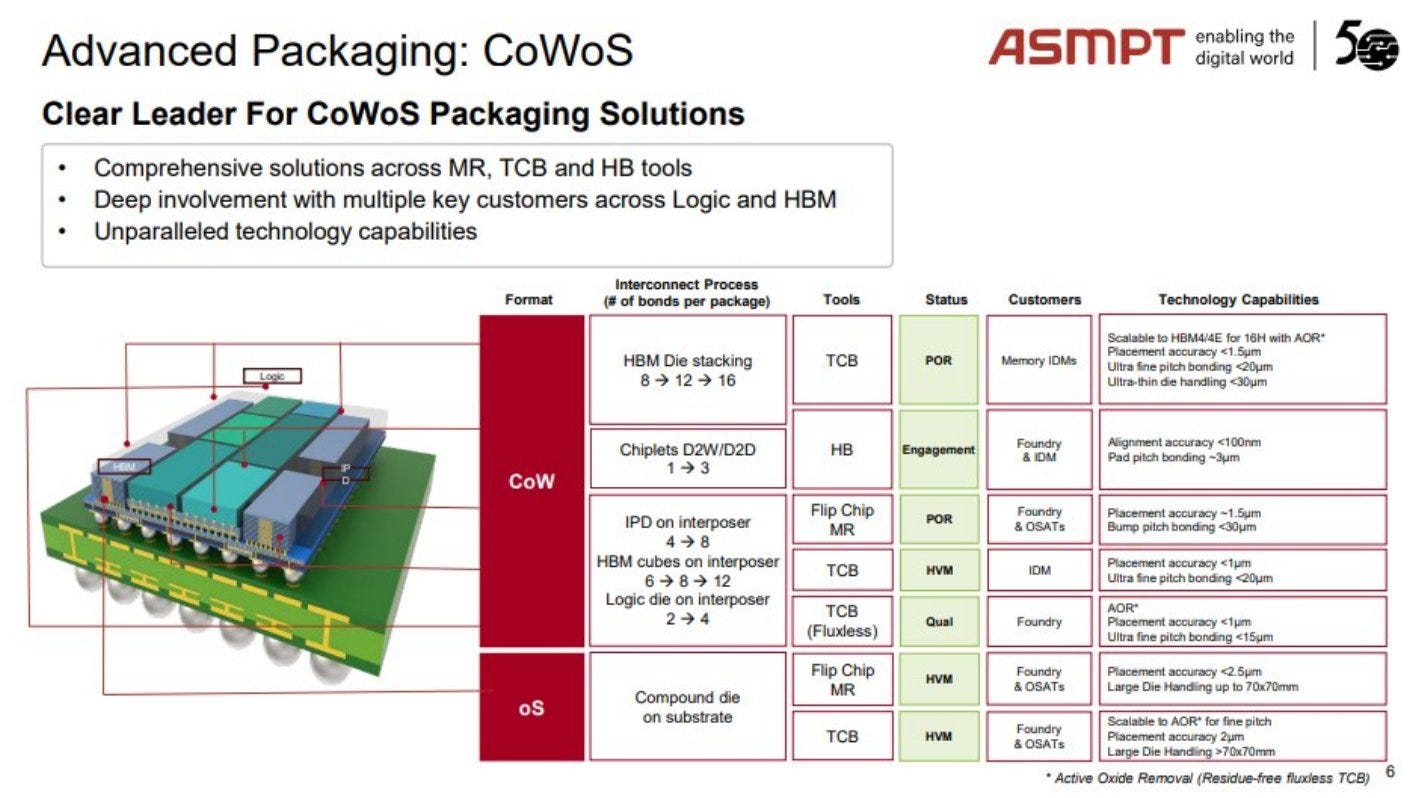
Nice map of ASMPT CoWoW solutions. h/t to SEMIVISION on X.
Sector Watch
Qualcomm and ByteDance in talks for custom chip design services for TikTok operations, highlighting China’s shift toward hyperscaler-owned ASIC capabilities amid export controls. (DigiTimes)
Samsung and SK Hynix report profit surges driven by hyperscaler demand for HBM, as contract structures shift toward direct deals bypassing traditional intermediaries. (chosun.com)
Apple iPhone 17 architecture teardown by TechInsights reveals engineering trade-offs in custom silicon to support next-generation mobile AI workloads. (techinsights.com)
Blue-X exploring sub-13.5nm lithography as alternative to EUV systems, potentially bypassing ASML’s monopoly if yield parity is achieved. (bits-chips.com)
Press Releases
Qualcomm accelerates diversification with a comprehensive strategy for the data center, anticipating multiple inflection points over the next 3 to 5 years. (Qualcomm IR, June 23)
Micron Technology, Inc. reports record results for the third quarter of fiscal 2026. (Micron IR, June 24)