Broadcom's AI forecast disappoints and Hock admits Google is drifting, TSMC says it can't make chips fast enough, and Stanford squeezes a 2D transistor down to 15 nm.
Earnings day blues for Broadcom: revenue’s up 48%, the AI chip forecast isn’t, and Hock Tan cops to Google building its own design muscle. Meanwhile, TSMC’s C.C. Wei says the foundry still can’t make chips fast enough and won’t be slowing CapEx any time soon. And Stanford scales a 2D nanoribbon transistor to 15 nm with record on/off ratios, a peek at what comes after silicon runs out of room. Plus: LPDDR6 elbows into the data center, InchFab sells $10M mini fabs to Roche, and budget phone makers eye the exits. Let’s dig in. 👇
Quick hits, high signal. Takes from semi industry experts. Sign up for free daily updates!
Be sure to check out the Semi Doped podcast on YouTube or your favorite podcast player!
Broadcom AI chip forecast misses estimates
Broadcom reported Q2 FY26 revenue of $22.19 billion, up 48% year-over-year and 15% quarter-over-quarter, with adjusted earnings of $2.44 per share versus a $2.39 consensus estimate. Shares fell in after-hours trading after the company’s AI chip sales forecast came in below Wall Street expectations and management reiterated, rather than raised, its $100 billion-plus 2027 revenue target. On the earnings call, CEO Hock Tan said Google is diversifying away from Broadcom for custom silicon. The company’s market capitalization stands near $2 trillion, compared with roughly $5.2 trillion for Nvidia. (Reuters)
Vik: Hock admitted that Customer-Owned Tooling (CoT — where customers own the chip design process) is real, and some share of custom ASIC design is bound to shift away from them. Broadcom’s self proclaimed silicon prowess is starting to show cracks when others execute just as well.
TSMC reaffirms 30%-plus 2025 revenue growth
At its annual shareholders’ meeting, TSMC Chairman and CEO C.C. Wei reiterated the foundry’s forecast for full-year revenue growth above 30%, citing AI demand shifting from generative and Q&A models toward agentic and command-execution workloads. Wei said chip supply will fall short of AI-fueled demand for years and indicated no slowdown in capital expenditure. He also confirmed that TSMC’s CoPoS advanced packaging technology is running on a pilot production line, with volume expected to ramp significantly over the next two to three years. Wei added that the company is expanding mature-node capacity and signaled interest in higher chip prices. (Bloomberg)
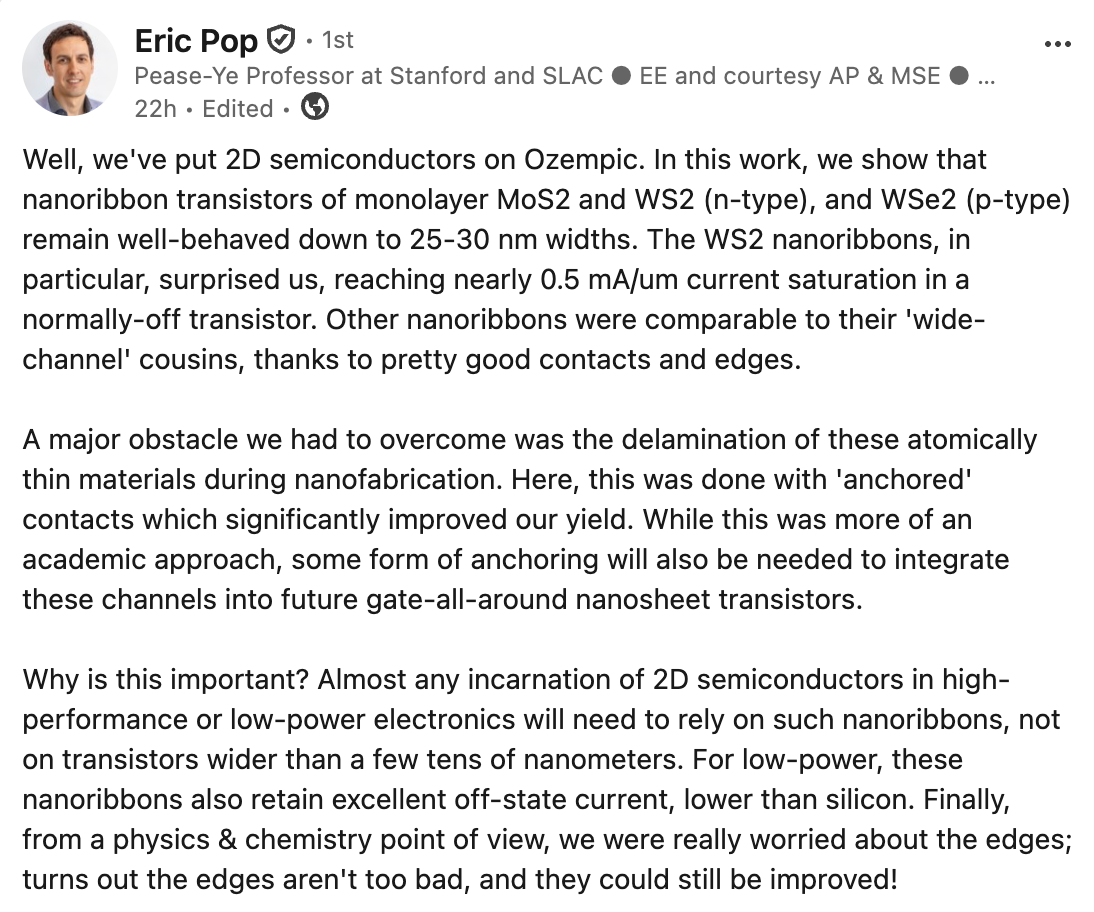
Stanford shrinks 2D nanoribbon transistors to 15 nm
Researchers from Stanford, Chalmers University of Technology, HORIBA Scientific, and SLAC published “Scaling nanoribbon transistors with monolayer transition metal dichalcogenides,” demonstrating monolayer and bilayer molybdenum disulfide nanoribbon transistors scaled down to 15 nm channel widths. The devices showed both n- and p-type operation and maintained on/off ratios of 10^6, the highest reported for similar dimensions. The team reported improved mobility and threshold-voltage stability at narrower widths, which the authors attribute to reduced edge scattering and depletion alongside stronger electrostatic control. Two-dimensional semiconductors provide the thinnest possible channel layer, but good performance had previously been limited to micrometer-wide channels. (Nature)
Austin:from Professor Pop on LinkedIn:
Quick Hits
Memory
JEDEC’s LPDDR6 roadmap adds data-center-oriented features, including higher bandwidth and reliability extensions, as LPDDR gains traction inside AI servers alongside HBM and DDR memory. (EE Times)
Semicap
Semiconductor laser annealing is gaining broader adoption beyond logic, expanding into SiC power devices and 400-layer NAND processes where conventional thermal treatment falls short. (@jukan05))
Infrastructure
Xnrgy, an AI data center cooling and power infrastructure parts maker, is exploring a sale that could value the company at roughly $10 billion. (Bloomberg Tech)
Foundry
InchFab is selling $10 million mini fabs to pharmaceutical maker Roche and universities, aiming to democratize chipmaking with compact lithography and processing tools for non-traditional buyers. (EE Times)
Packaging
Genesem completed development of vacuum and flip mounters for advanced HBM packaging, signaling rising orders as HBM3E and HBM4 ramps draw fresh demand for assembly equipment. (The Elec)
Networking
Cisco positioned its Silicon One platform for secure agentic-AI networking, emphasizing in-band telemetry, segmentation, and traffic-isolation features built for AI training and inference fabrics. (Cisco Blogs)
Consumer
Mid- and low-end handset vendors are eyeing exits from the smartphone market as elevated memory prices, war-related component shortages, and weak demand pressure margins, Counterpoint warned. (Light Reading)
That’s it for today!
Thanks for reading! This post is public so feel free to share it.