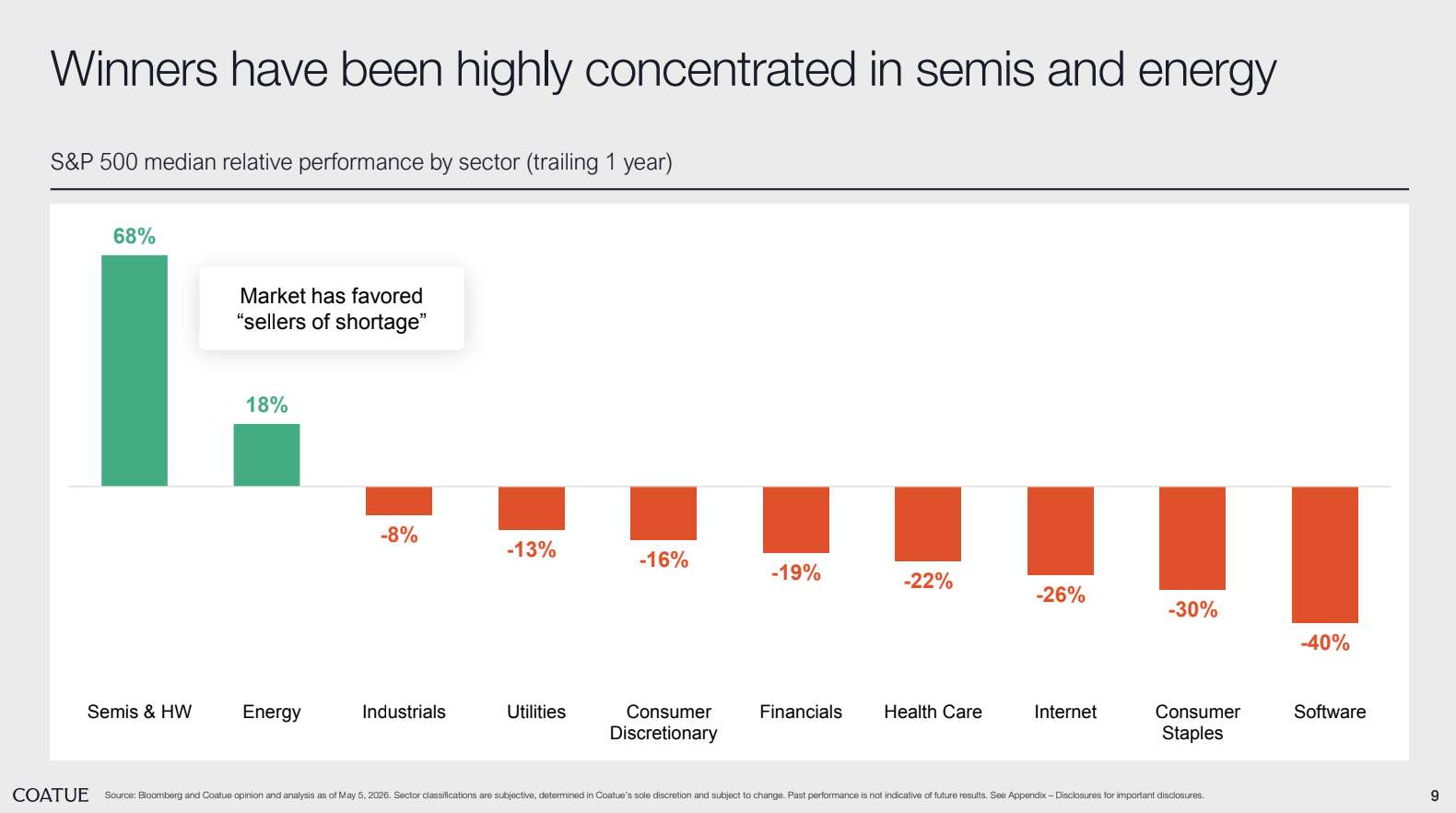
This semi market is insane. Pick any stock and it only goes up. Or so it seems at least. And those that haven’t spiked, appear to do so sooner or later. Focusing on the fundamental technology is still the highest alpha activity possible. MicroLEDs picking up steam, Thinking Machines has a cool model out, and EMIB is becoming more important. TIL section today about how the “bunny suit” came about.
Lots of happenings today. Lets get into it.
Vik: My tweet went super viral for just saying that analog electronics is hard. LOL. Read my follow up tweet with more context.
Quick hits, high signal. Takes from semi industry experts. Sign up for free daily updates!
Be sure to check out the Semi Doped podcast on YouTube or your favorite podcast player!
MicroLED CPO market to reach $848M by 2030
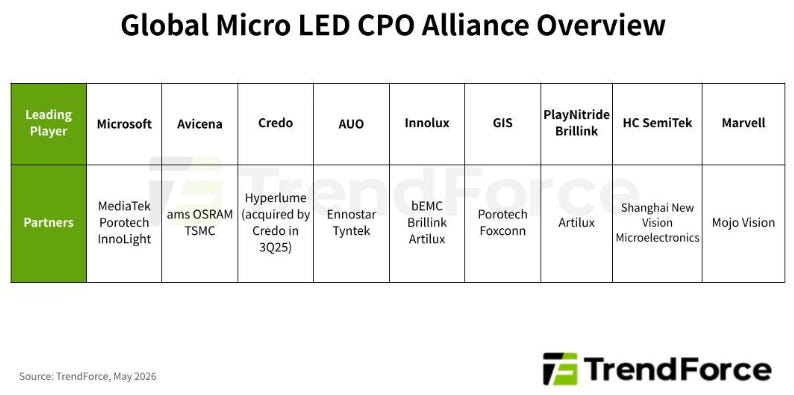
Trendforce predicts that the demand for microLEDs along with active electrical cables (AECs) and VCSEL-based near packaged optics (NPO) will occupy a significant portion of the interconnect market, especially for scale-up. Scale-up has a lot of cables and is the biggest networking TAM in a datacenter. The sheer number of cables means that interconnects must consume power as low as 1-2 pJ/bit, with very low bit-error-rates (BERs) in the range of 10^-12.
Here’s a table from TrendForce about the state of the microLED market.
Austin has a good deep-dive on VCSELs at 200G for short reach interconnect, with more to come in the future.
Thinking Machines Lab ships its first frontier model, applying the bitter lesson to real-time multimodal AI
Thinking Machines Lab released “Interaction Models” — a research preview of TML-Interaction-Small, a 276B-parameter MoE (12B active) trained from scratch to natively process continuous audio, video, and text in 200ms micro-turns, rather than wrapping a turn-based model in voice-activity-detection scaffolding the way OpenAI’s GPT-realtime and Google’s Gemini-live do:
Vik: That video is cool. It does real time language, and does web search while talking and listening. Its nice to see something concrete like a small model come out of Thinking Machines. Wonder what else they have cooking. Now I wonder what Ilya’s SSI labs are working on. I hope they release something.
Austin: All I can think of is Scarlett Johansson from Her.
SK hynix is testing Intel’s EMIB (Embedded Multi-Die Interconnect Bridge) 2.5D packaging technology for high-bandwidth memory as TSMC’s CoWoS capacity becomes constrained. CoWoS is built on silicon interposer and has a higher interconnect density, at higher cost. EMIB is built on organic substrate, and while lower cost, has lower routing density. But under CoWoS supply constraints, EMIB serves as a great alternative.
If you need more context, check out these deep dives:
Meta rolls out Labyrinth 1.1 encrypted storage system and protocol to improve Messenger message and history backup security (Meta Engineering)
CoreWeave leads Kimi K2.6 benchmark for speed and cost efficiency while insider dumps $370M stock following recent gains (CoreWeave)
AWS previews Bedrock AgentCore with managed payment capabilities enabling autonomous AI agents to complete transactions without human intervention (AWS Blogs)
LITE 0.00%↑ stock surges significantly on optical strength and gains Nasdaq-100 index inclusion reflecting leadership position in AI optical sector. AAOI 0.00%↑ is way up to due to rising demand across 400G, 800G, amd 1.6T.
TIL: Intel’s iconic “Bunny Suit” was born out of a 1970s pizza-warming crisis.
In the early days of semiconductor manufacturing, cleanroom standards were… relaxed. Legend has it that technicians at Intel’s Fab would occasionally use the diffusion furnaces - machines meant for doping silicon wafers - to keep their pizzas warm. By 1973, as transistors shrunk and “human lint” became a legitimate threat to yields, Intel officially introduced the “Bunny Suit” at Fab 3 in Livermore.
The name wasn’t a corporate branding play; it was a joke. Technicians felt the baggy, white polyester jumpsuits made them look like oversized rabbits. For decades, it remained a drab necessity of the fab floor until 1997, when Intel’s marketing team turned the “BunnyPeople” into disco-dancing superstars to launch the Pentium MMX as a XXXI Superbowl ad.
The campaign was so absurdly successful that the ads debuted during Super Bowl XXXI, and Intel eventually sold plush BunnyPeople dolls that are now genuine collector’s items. Today, the suit is more high-tech than ever - utilizing ePTFE membranes (Gore-Tex) to block particles as small as 0.1 microns, or roughly 1/700th the width of a human hair.
Despite its pop-culture fame, wearing one is less “disco” and more “sensory deprivation.” It’s a multi-step “gowning” ritual that requires covering everything from eyelashes to ankles, a process so iconic (and claustrophobic) that an original suit is now a permanent historical artifact at the Oregon Historical Society.
Thanks for reading! This post is public so feel free to share it.