
Daily Update - May 5th, 2026
Apple looks past TSMC, Fabrinet beats and gets sold, Samsung restarts SiC, and more.

Supply constraints are driving the news today. Apple is reportedly considering Intel and Samsung as secondary fabs for US-made chips. Fabrinet posted a record $1.21B quarter and still got punished. Samsung restarts SiC production.
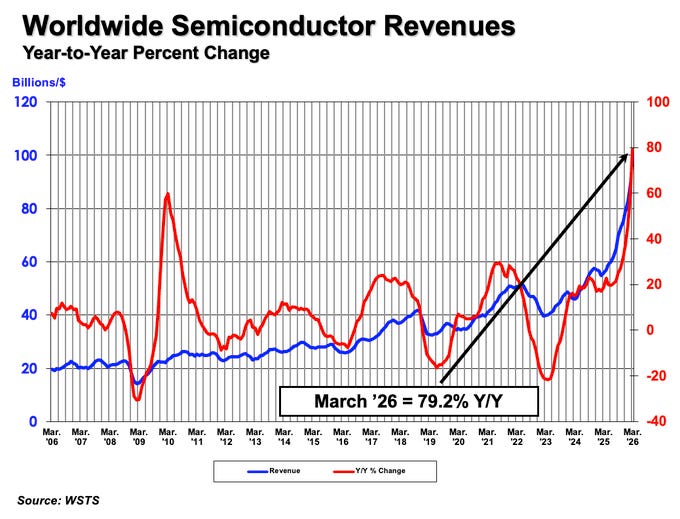
In other news, Lattice Semiconductor grabs AMI for $1.65B to push deeper into datacenter firmware. Semi YoY revenue hits 79.2% in March.
And finally, we’re tuning in to AMD earnings this Cinco de Mayo:

Austin: I’m expecting EPYC CPU server sales, but my Instinct is that investors won’t hear as much datacenter accelerator news as they’d hope. Let’s see if Stacy Rasgon asks about it.
Apple Considers Using Intel, Samsung to build US chips
From Bloomberg: Apple is considering using Intel or Samsung as an alternative to long-time manufacturer TSMC because chip supply shortages are hurting Apple’s capacity to produce devices. Industry observers like Ben Thompson have warned that TSMC’s CapEx commitments from earlier this year are still too conservative, and that it will ultimately come back to bite them. From Stratechery,
Specifically, if we get to 2028, and TSMC still isn’t producing enough chips to satisfy demand, then that means the hyperscalers will be forgoing billions of dollars in revenue — even more than they are already forgoing today. Yes, that risk is harder to see than the risk TSMC is avoiding, because the hyperscalers aren’t going to be bankrupt for a lack of chips to satisfy demand. Still, the potential money not made — particularly when the number is potentially in the hundreds of billions of dollars — is very much a risk that the hyperscalers are incurring because of TSMC’s conservatism.
Nothing is written in stone yet, but Apple switching to Intel/Samsung would be validation of this risk, and is a big win for Intel who has needed a whale customer for years, despite their differences with Apple over the years.
Austin: If/when this happens, we need a Howard Lutnick photo with both Lip-Bu Tan and Tim Cook.
Fabrinet FN 0.00%↑ falls short in investor eyes
Fabrinet posted record numbers in their Q3-2026 earnings call: $1.21B in revenue, up 39%, ahead of expectations. The stock still dropped ~13% after hours. Market focus was on 3 negatives: supply constraints, negative FCF+inventory buildup, Q4 guidance not above consensus. This is despite explosive YoY growth, and 90% growth in DCI.
Vik: The important thing is that FN does not make components, but only assembles them into transceivers. If there is a shortage of components like InP lasers, then they are directly affected downstream. It seems like optics expectations have run up high, and investors now sell on disappointment.
Austin: Yeah, good point. Worth adding that Fabrinet does fab some pieces in-house, mostly passive customized optics and glass like crystals, lenses, prisms, mirrors, substrates (per the 10-K). But if there’s supply constraints with the III-V active stuff (InP lasers, modulators, photodiodes), or memory, or DSPs/retimers for transceivers, Fabrinet is squarely downstream of those suppliers. So your framing holds: when component supply tightens or expectations get ahead of the ramp, FN takes the hit even though they’re executing.
That said, optoelectronics is vital to optics in the AI datacenter (pluggables today, co-packaged optics tomorrow, and eventually optical I/O on the package itself) and LiDAR scaling into automotive as ADAS and autonomy keep climbing the S-curve.
So short-term noise around a quarter of supply constraints and inventory builds doesn’t change that long-term narrative imo.
Quick Hits
Power market heating up as Samsung restarts SiC production targeting mass production in 2028, competing with ON, ST Micro, and Infineon. Some advise caution especially when SiC is dominated by Chinese manufacturers.
Lattice Semi LSCC 0.00%↑ acquiring AMI for $1.65B that doubles SAM and is immediately accretive to gross margin by addressing datacenter deployment and uptime by combining lattice FPGAs with AMI’s firmwire solutions.
Key Data
Great time for semis as YoY revenue change hits 79.2% in March 2026.
Earnings Watch This Week
Tue = AMD 0.00%↑ LITE 0.00%↑ ALAB 0.00%↑ GFS 0.00%↑ ANET 0.00%↑
Wed = COHR 0.00%↑ ARM 0.00%↑ SITM 0.00%↑
Fri = WULF 0.00%↑
TIL: The “Christmas Present of 1947” that keeps on giving
The transistor story starts with a patent filed in Canada in 1925 by Julius Edgar Lilienfeld — a physicist who sketched out the basic concept of a field-effect transistor, never built a working device, and faded into obscurity. That detail matters later.
On December 16, 1947, Bell Labs physicists John Bardeen and Walter Brattain tested the first working semiconductor amplifier — a plastic wedge wrapped in gold foil, pressed against a slab of high-purity germanium. They demonstrated it to Bell Labs leadership on December 23, in what Shockley called “a magnificent Christmas present”. More here.
Then the lawyers got involved. Bell Labs’ patent attorneys found that Shockley’s own theoretical writings were too close to Lilienfeld’s prior art to hold up in court — so his name was left off the applications entirely. Furious, Shockley went to Chicago for a physics conference and spent New Year’s Eve in a hotel room sketching roughly 30 pages of notes for a completely new design: the Junction Transistor, which dominated the industry into the late 1970s.
Bell Labs sat on the invention for six months, terrified the government would classify it as a national security secret. When they finally announced it on June 30, 1948, a spokesman called it something that “may have far-reaching significance.” The name “transistor” was coined by John Robinson Pierce, a Bell Labs engineer who moonlighted as a science fiction author. All three inventors shared the 1956 Nobel Prize. The full IP drama is worth your time.