
TIL: The Calculator Wars And the Revenge That Took a Decade
The Playbook That Keeps Coming Back

Whether you made graphs with your calculator or wrote 5318008, the calculator was a staple in your life. But there was a long, long, time ago, when some of us can still remember how the music used to make us smile, or that the desk was a battlefield, and the weapon of choice was the electronic calculator.
In the early 1970s a thing called the “Calculator Wars” broke out, and it behaved less like ordinary market competition and more like the opening skirmishes of the consumer microchip age. At its peak, it was a frantic, high-stakes game of attrition in which Bowmar, Commodore, Rockwell, and Texas Instruments fought to cram as much logic onto a single grain of silicon as anyone had thought possible.
In 1972 a humble four-function calculator (add, subtract, multiply, divide; that was the entire feature list) cost about what a high-end smartphone costs today. Executives carried them into boardrooms the way they carried Swiss watches. By 1975 the same machines were sitting in drugstore bargain bins for the price of a decent dinner.
The kicker is that none of these brands made their own chips; most of them were, to put it unkindly, glorified assembly shops. They bought the hard part (the calculator-on-a-chip, the kind of Large Scale Integration (LSI) that Texas Instruments had figured out how to mass-produce in 1971) and bolted on a keyboard, a display, and a logo. Bowmar built its famous “Brain” around a TI chip and TI’s clicky Klixon keypad; it listed at $240 in 1971, something like $1,800 in today’s money. Commodore’s first calculator was, charmingly, a Bowmar in different packaging. And the company quietly supplying much of the industry with its single most important component was... Texas Instruments.
You can probably see where this is going.
Texas Instruments did not win the Calculator Wars by building a nicer gadget. It won by turning its own supply chain into a weapon. TI looked at all these assemblers buying its chips, marking them up, and pocketing the difference, and decided it would rather keep the whole margin for itself. So it began selling finished, TI-branded calculators straight to shoppers; and it priced them, in many cases, below what it was charging its own customers for the raw components inside.
If you were Bowmar or Commodore, the same company that sold you your most expensive part was now selling the finished product for less than your bill of materials came to, because vertical integration. You could not cut your price to match without bleeding out, and you could not switch suppliers, because TI also happened to own the cheapest way to make the thing. It was a pincer with no exit.
The Japanese pressed from the other side of the ocean - Casio with its dirt-cheap Mini and Sharp with its low-power displays. By early 1975 the squeeze had pushed Bowmar into bankruptcy, and most of the small assemblers went down with it. TI walked away owning the American calculator; decades later it would parlay that win into the near-total grip on classroom graphing calculators that students still grumble about today.
And here the story takes its best turn, because one of the assemblers TI gutted refused to die quietly.
Commodore’s boss, Jack Tramiel, a man whose credo was “business is war” and meant every word of it, was incandescent at being undercut by his own supplier. He drew the obvious lesson: never be a tenant again; own the building. In 1976 he bought MOS Technology, the chip outfit whose engineers (Chuck Peddle among them) had just designed a quiet little processor called the 6502. (MOS Technology, confusingly, is not the same company as Mostek; the 1970s were simply lousy with semiconductor firms whose names started with “MOS.”) Tramiel now had his own silicon, and a CPU that would go on to power the Apple II, the Atari, and the Nintendo.
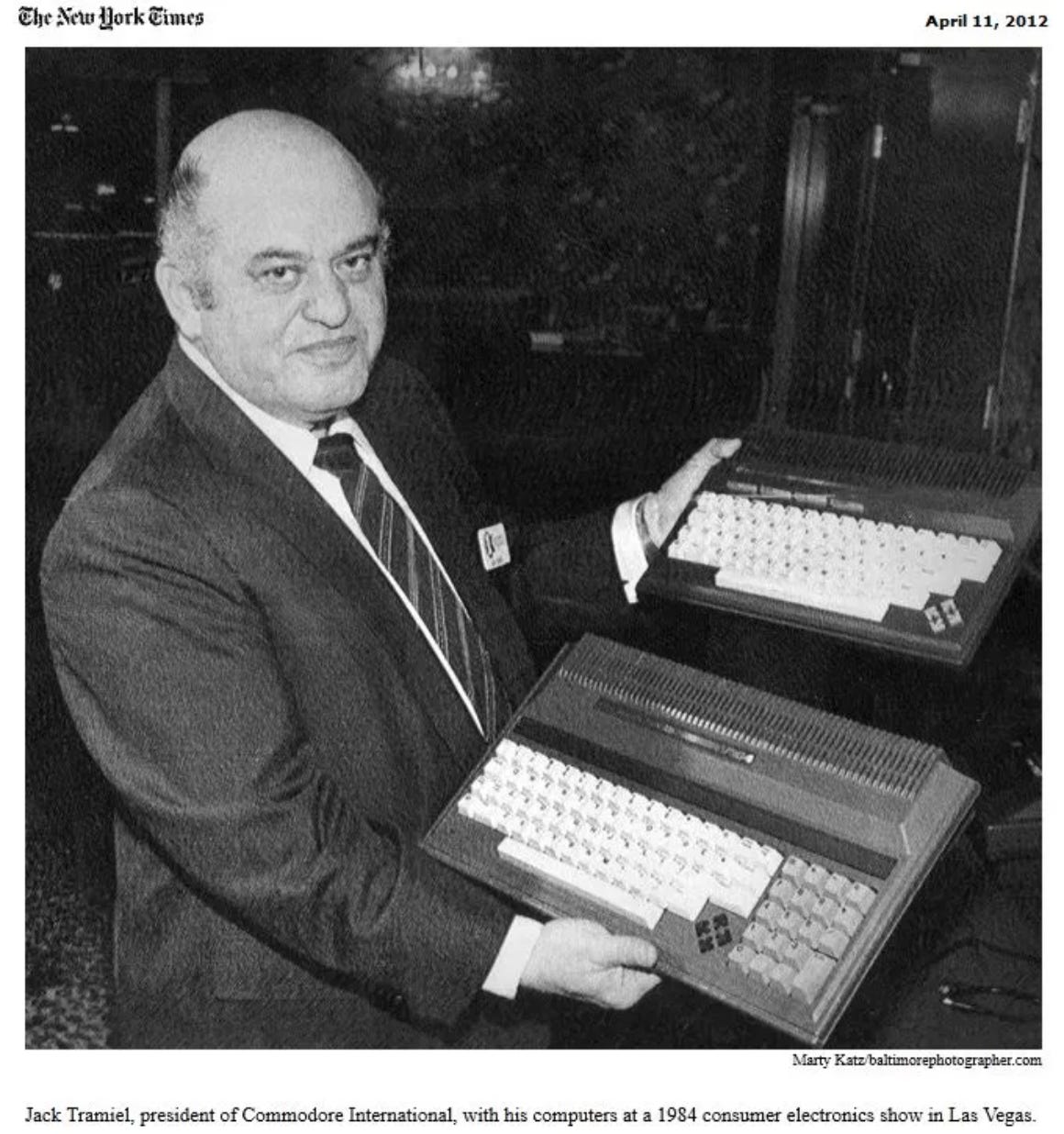
Then he waited.
When the home-computer era arrived in the early 1980s, Tramiel pointed TI’s own playbook straight back at TI. He slashed the price of the VIC-20 and then the Commodore 64 again and again, the way only a man who owns his chips can, and ground TI into the floor. In late 1983 TI quit the home-computer business altogether.
All of this is worth keeping in mind while we watch the current scramble for AI hardware at the edge. The rhythm keeps recurring: a chipmaker enables a brand-new class of device, integrates downward to squeeze out the assemblers buying its parts, then provokes a wave of defensive vertical integration from whoever survives. Nvidia moving into full systems; Apple, Amazon, and the hyperscalers rolling their own accelerators.
The cast is new, but the movie is very old, and somewhere out there is the next Tramiel.
Thanks For
Sharing Your Excellent Knowledge We Who Are Products Of The Old School Understand Exactly What You Are Saying
And We Appreciate You Sharing The Experiences And Information That The Old Guard Grew Up With To Another Generation Of Young People
We Appreciate Your Wisdom In A Time Where The Majority Of Technology Has Come To Literally Eradicate Everything About Our Shared Histories And Our Knowledge From Our Past Generations!!
I’m Proud To Share With You All My Skepticisms Of Our Current Technological Futures!
We Have Been Numbed With This Technology And We Are Presently So Ingrained Our Own History Is Being Erased From Our Very Own Being In Every Culture In The World!!
Unfortunately We Are Losing This War Because It’s Like Trying To Boycott The Extreme Market Of Goods That Are Being Bought From Other Countries!