
TIL: Qualcomm Bet the Company on Trucks Before It Bet on Your Phone
How a satellite tracker for eighteen-wheelers funded a wireless idea everyone else called impossible, and why the company may be running the same play again.

In 1989, the company that would eventually take a cut of nearly every smartphone on earth made half its revenue tracking eighteen-wheelers for a single trucking firm.
The company was Qualcomm, founded in 1985 by seven engineers who had left a San Diego outfit called Linkabit. Irwin Jacobs and Andrew Viterbi led the group, and they gave their new venture a name of almost defiant plainness: a portmanteau of “Quality Communications.” They had a big idea about how radio spectrum could work. They did not, yet, have a way to pay salaries with it.
So while that idea matured, they built something far less glamorous: OmniTRACS, a satellite terminal bolted to the roof of a truck cab, letting a dispatcher a thousand miles away see exactly where his fleet was and radio instructions straight to the driver. It was logistics software before logistics software was cool, and by 1989, one customer, Schneider National, accounted for half of Qualcomm’s $32 million in revenue.
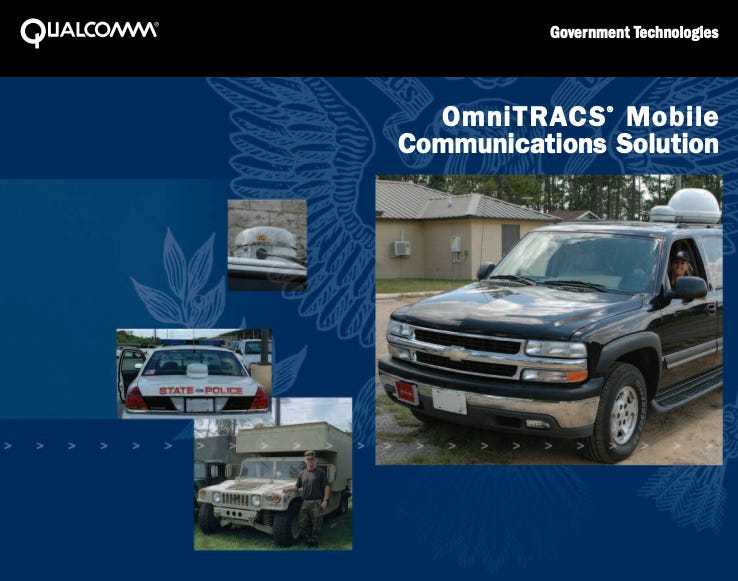
That trucking money bought Qualcomm time, and it needed every bit of it, because the big idea was a hard sell.
It was called CDMA, and the concept struck most of the cellular industry as slightly unhinged: instead of making callers politely take turns on a channel, let everyone speak at once, with each voice wrapped in its own mathematical code and untangled at the receiving end.
The industry had already committed to a rival approach, TDMA, and when Qualcomm proposed CDMA in 1989, the response was a firm no. Engineers called it unworkable. The Wall Street Journal published warnings that a failure at scale could cost the industry billions. People in the trade still refer to the fight as the Holy Wars of Wireless, which tells you how seriously everyone took it.
Qualcomm won anyway.
The FCC ruled that carriers could deploy whatever standard they liked, so Qualcomm skipped the gatekeepers and sold CDMA straight to the operators. It became a formal standard in 1993 and went on to underpin the entire third generation of mobile networks. The industry has since moved on to newer methods for 4G and 5G, but Qualcomm’s patents and modems came along for the ride regardless.
The technology that respectable engineers had declared impossible became the thing an entire generation of phones was quietly built on, paid for in its infancy by keeping tabs on trucks.
As Qualcomm now reforms itself into an AI datacenter company, it could really use some of that early magic that made them the kingpin of communications technology for decades.
Could High Bandwidth Compute be it?
