
TIL: The Microwave Was a Radar Accident
It's inventor never finished grammar school and got $2 for it

In 1945, a self-taught engineer named Percy Spencer was standing in front of a running magnetron at Raytheon. The magnetron is the vacuum tube that pumped out the short radio waves for Allied combat radar, and Spencer had pushed Raytheon’s production from 17 magnetrons a day to 2,600 a day during the war. On a particular day, he noticed the candy bar in his pocket had quietly turned to goo while he stood there.
Aside: Magnetron sounds too close to Megatron. Now I’m worried my microwave is a Decepticon and is coming to get me.
A magnetron throws out microwaves at ~2,450 MHz. Water molecules are polar, so they flip back and forth trying to line up with that oscillating field billions of times a second, and all that molecular friction shows up as heat. The microwave does not cook “from the inside out” (a myth that started right here, with this exact discovery). It penetrates a few centimeters and excites the water in that layer directly, instead of heating the surface and waiting for it to conduct inward the way your oven does.
Some people say it was a PayDay bar, but nobody fully agrees. Most accounts say a plain chocolate bar; Spencer’s own grandson insisted it was a peanut cluster bar (he gave them to the squirrels outside the lab), which is the better version because peanuts and caramel melt at a much higher temperature than chocolate.
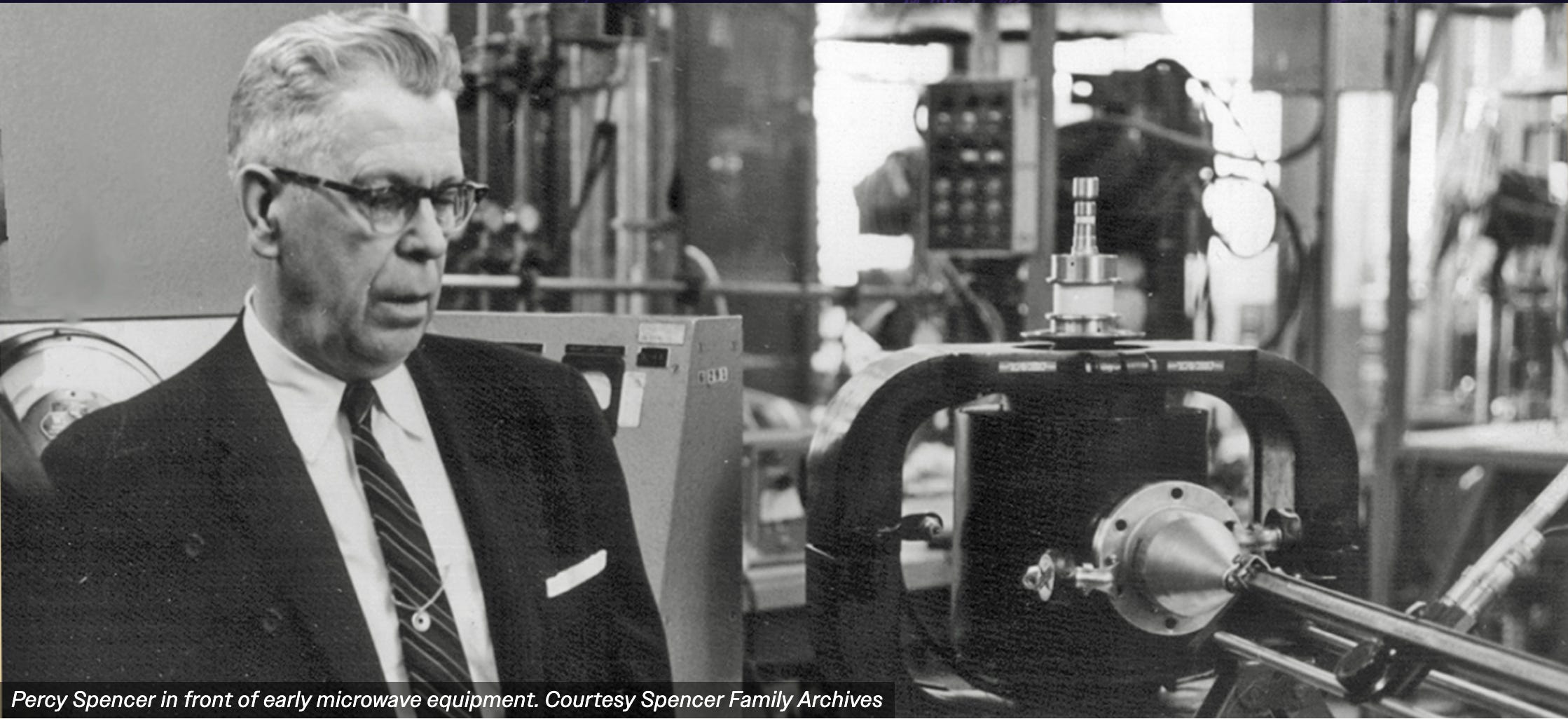
Spencer did what any curious engineer would do and aimed the tube at food. First came popcorn kernels, which popped across the lab floor; popcorn was the very first thing he microwaved on purpose, and it is still one of the most common things we microwave today. In another experiment, an egg was placed in a tea kettle, and the magnetron was placed directly above it. The result was the egg exploding in the face of one of his co-workers, who was looking in the kettle to observe. Spencer then created the first true microwave oven by attaching a high-density electromagnetic field generator to an enclosed metal box. The magnetron emitted microwaves into the metal box blocking any escape and allowing for controlled and safe experimentation. He then placed various food items in the box, while observing the effects and monitoring temperatures. There are no credible primary sources that verify this story.
Raytheon saw the gold mine. They filed the patent on October 8, 1945, ran an internal naming contest, and the winning entry combined “radar” and “range” into the Radarange. The first commercial unit shipped in 1947 and went to a Cleveland restaurant. It was a monster: nearly 6 feet tall, 750 pounds, and around $3,000 (north of $50,000 today). The 3 kW magnetron ran so hot the unit needed its own plumbing line for water cooling. This was not an appliance; it was industrial equipment for restaurants, ships, and military kitchens.
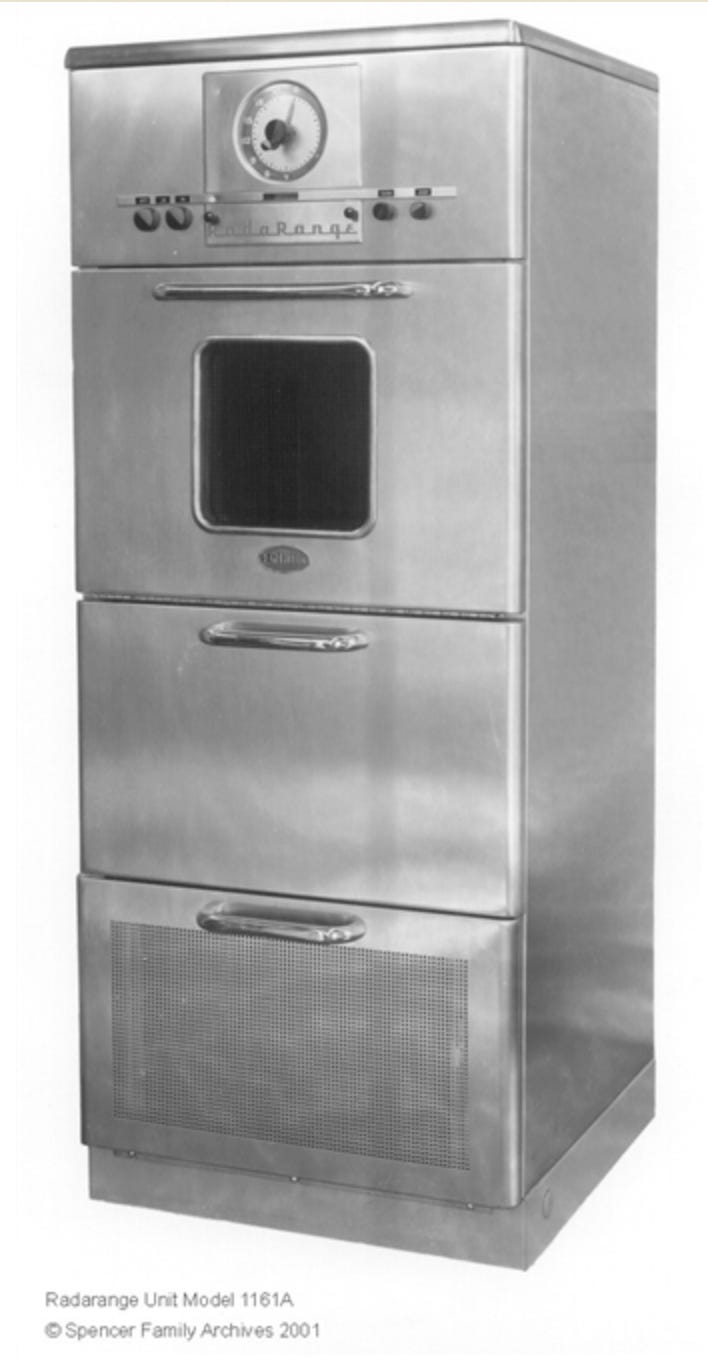
It took twenty years to shrink. In 1967, Amana (a Raytheon subsidiary by then) released the first countertop Radarange for $495 — still pricey, but finally something you could put on a kitchen counter. By 1975, Americans were buying more microwaves than gas ranges, and today the thing sits in roughly 90% of US homes.
For kicking off a multi-billion-dollar global appliance category, Raytheon paid Spencer their standard reward for any employee patent: a flat $2 and no royalties. He did fine anyway, retiring with around 300 patents on the strength of a fifth-grade education. MIT’s take on him was that the trained scientist knows in advance what won’t work, while Percy simply didn’t know what couldn’t be done, so he kept cutting and fitting and trying until something did.
One last thing, because this is Semi Doped. The magnetron at the center of this story is a vacuum tube, pre-semiconductor technology, and it never left. The microwave humming in your kitchen tonight is still driven by a magnetron, which makes it one of the last working vacuum tubes most people still own. A piece of 1940s radar hardware, quietly outliving the entire transistor revolution it helped kick off. Like the chicken and the T-Rex.