
TIL: Things once found in a now-flooded Swedish ditch are hiding inside your electronics
Some of them now do quiet, very specific jobs inside semiconductors.

TIL that one abandoned quarry in a Swedish village called Ytterby gave the periodic table the better part of a dozen elements, and that a few of them now do quiet, very specific jobs inside semiconductors.
There is this flooded pit on a small island outside Stockholm that used to be a quarry for quartz and feldspar - the dull stuff that glass and porcelain are made of. In 1787 a Swedish army lieutenant named Carl Axel Arrhenius, who collected rocks the way other officers collected debts, picked up a heavy black stone there and decided it was a new tungsten mineral. He was wrong. What he had actually found was a sampler plate from the bottom of the periodic table.
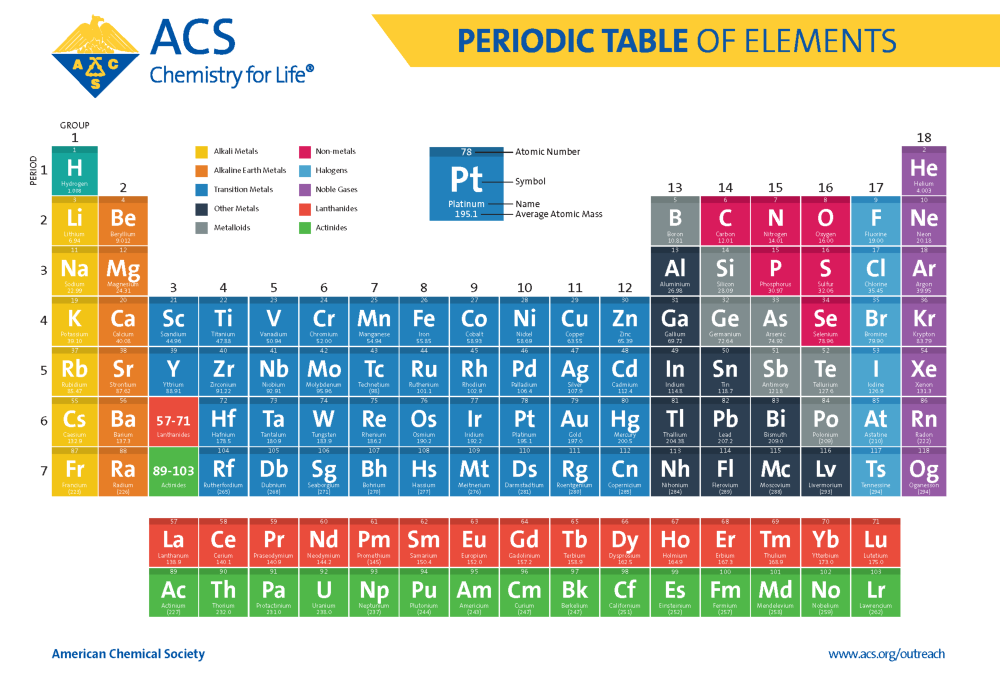
Over the next century, chemists kept teasing new elements out of that one rock and its relatives. Four are named directly after the village: yttrium, terbium, erbium, and ytterbium. Several more, holmium, thulium, scandium, gadolinium, and the heavy metal tantalum, were first pulled from the same minerals. For two hundred years this was pure pub-quiz material for the chemistry nerds. Then silicon started running out of road, and the toolmakers went looking in the strange middle of the periodic table for help.
Why these elements and not others? It comes down to where they keep their electrons. Ordinary silicon chemistry happens on the outside, with electrons shared politely between neighbours. Most of the Ytterby metals are lanthanides, and they tuck extra electrons into an inner shell - the 4f - that sits buried under the outer layers like a letter inside two envelopes. Shielded from the chemical traffic outside, those buried electrons keep very clean, very sharp magnetic and optical behaviour, which is exactly the sort of tidy quirk an engineer will travel a long way to use.
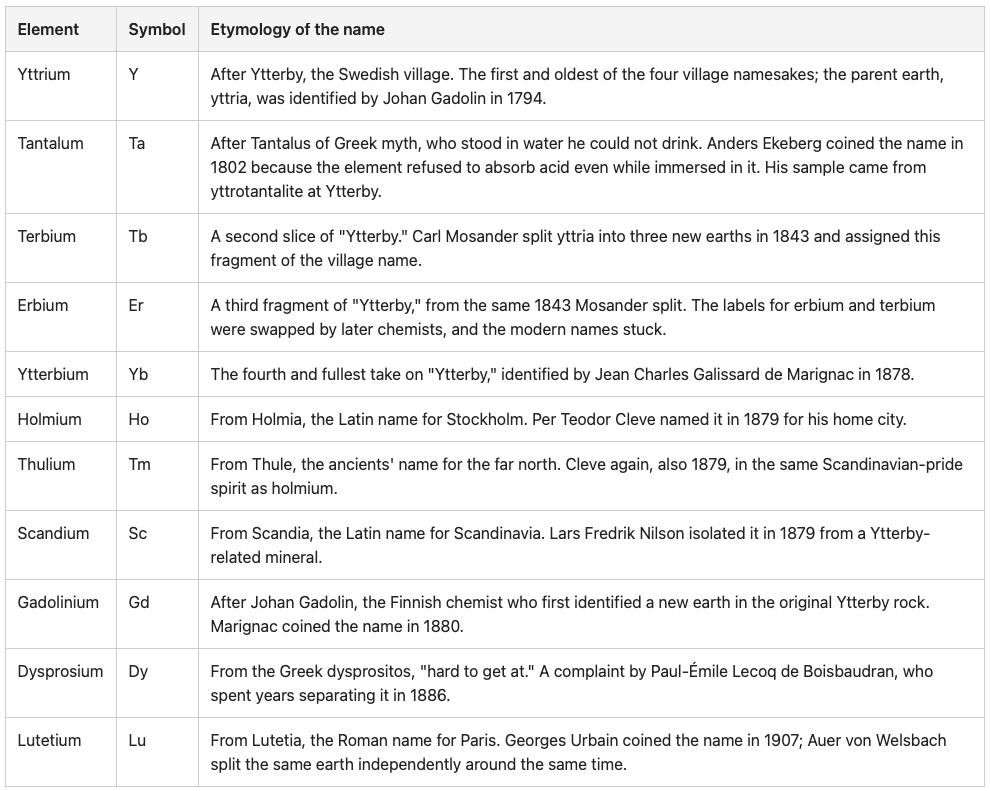
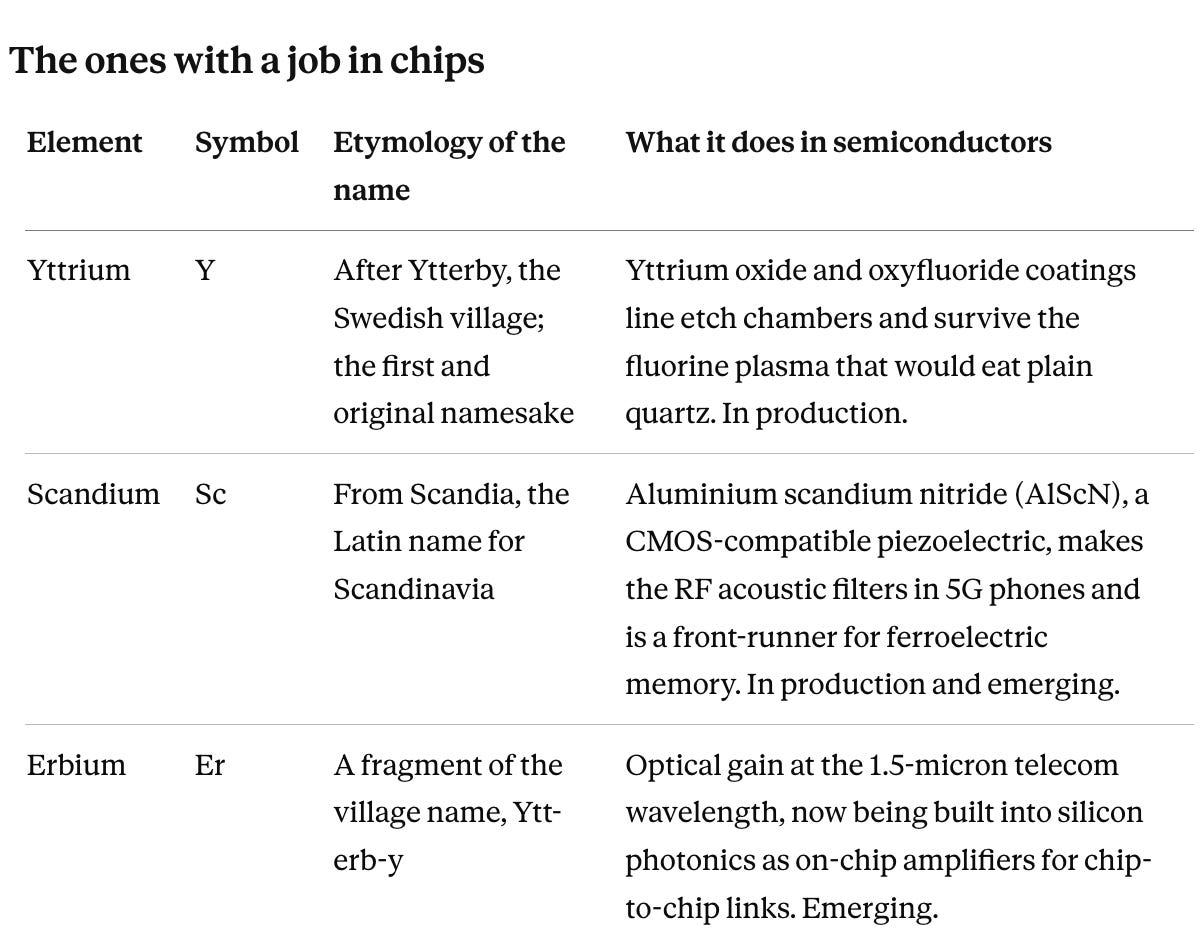
The surprising part is that only a few of them earned a real job in a chip, and the jobs are oddly specific.
Yttrium is the bodyguard: when a fab etches features into a wafer it uses fluorine plasma that would chew an ordinary quartz chamber to lace, so the chambers are lined with yttrium oxide, one of the few coatings that can stand in that fire without flaking.
Scandium is the quiet success of the group, alloyed into aluminium nitride as AlScN to make the radio-frequency filters inside 5G phones, and now a leading material for a new kind of memory.
Erbium is the relay runner, doped into glass to amplify light at the wavelength where optical signals travel furthest, the trick behind fibre-optic telecom, and now being built straight onto silicon to move data between chips.
The strangest thing I learned is what tantalum does.
It was found at Ytterby in 1802, it is not a rare earth, and almost nobody thinks about it. Yet a thin layer of tantalum nitride lines the copper wiring on very nearly every chip made today, which makes the most anonymous element from the quarry the one you are most likely to be holding right now.
The rest are still mostly famous for things they cannot quite do yet.
Ytterbium makes a fine qubit, but for trapped-ion quantum computers that do not use chips at all.
Holmium has the highest magnetic moment of any natural element and once held a single bit of data on a single atom in an IBM lab.
Lutetium was the great hope for a sharper lithography lens that never reached production. Again, good pub trivia, but not much silicon.
The elements from that quiet ditch are not rare in the crust, only rare in concentrations worth mining, and the world now buys nearly all of them through a very small number of doors.
China mines about 70 percent of rare earths and refines close to 90 percent. The famous Bayan Obo mine in Inner Mongolia mostly yields the light ones; the heavy members of the roster come largely from clay deposits in southern China and from Myanmar. The United States has essentially one mine, Mountain Pass in California, and Australia’s Mount Weld is the main door that does not open onto China.
So the last thing I learned today: in 2025 China put export controls on seven rare earths, and several of them, yttrium, scandium, terbium, dysprosium, gadolinium and lutetium, came straight off the Ytterby list. A 250-year-old quarry, found by a man who misidentified his own rock, is now a line item in a trade war.
Nice. A cool side note. Not in electronics but SOFCs made by Bloom Energy uses a lot of scandium and some Yttrium. Ceres uses Gadolinium-Doped Ceria. Bloom will consume a good amount of scandium if they scale from byoEnergy mandates.